So Far, So Good
So far, our move to Korea has gone remarkably well.
We did a lot of planning before we left, and most of it has paid off. There have been hiccups, of course, but most have involved exactly what you would expect when moving to another country: government offices, paperwork, rules we didn't know existed, and documents that apparently have expiration dates nobody thought to mention.
Our best example started on July 22, the day before we left Austin, when we discovered almost by accident that Korea had just imposed a six-month limit on apostilled FBI background checks. The rule had taken effect on July 2.
Our background check was now too old. Great timing.
The fix isn't terribly difficult when you're still in the United States. Once you're in Korea, though, it gets a lot more complicated. So we immediately went to the FBI website and requested a new background check. The FBI said, in effect: Fine. Go get fingerprinted.
So QLA BBR — Quick, Like A Big Bunny Rabbit — we hopped in the rental car and headed to the post office. My wife had her fingerprints taken electronically and sent to the FBI. That part was almost absurdly easy. About 45 minutes later, we had the new FBI background check.
Then came the apostille.
An apostille is basically the federal government's certification that the FBI document is authentic. And unlike the FBI check itself, this isn't something you knock out in 45 minutes.
We found a small company online that handled the process. They were cheaper than most, promised a fast turnaround, and said they could FedEx the finished document to us in Korea. We took a chance, and that turned out to be a very good decision.
The company, run by a brother and sister, was excellent. We got automated status updates as the document moved through the process. When something went wrong at the State Department, they didn't just send us a generic email. They jumped on it. We got emails, texts, and even a phone call explaining what had happened and what they were doing about it. By then, of course, we were in Korea, and the clock was running.
We had an appointment at the immigration office in Seoul to apply for our Korean residence cards. My F-1 paperwork went through without much trouble. My wife's F-4 application needed a couple of additional documents, including proof that she had attended school in Korea.
That particular snag turned out to be useful. Her Korean school records also proved that she had grown up here, which meant she didn't need to take the classes intended to teach newcomers about Korean society. One bureaucratic requirement had accidentally eliminated another.
But we still had the apostille problem.
My wife explained what had happened to the immigration official: the six-month rule was brand new, we had discovered it the day before leaving the United States, the replacement was already being processed, and we were waiting for it to arrive. The official listened, we submitted everything else we could, and we went back to our Airbnb. The plan was to return about a week later with the last documents.
So we waited, with our fingers crossed that the apostille would make it to Korea in time.
A few days later, both my wife and I missed calls on our temporary Korean phone numbers. Neither of us recognized the number, so naturally we assumed it was spam or phishing.
It wasn't. It was the immigration office.
The official was calling to tell my wife that she didn't need the new apostille after all. They already had her previous apostilled FBI check on record, and since the six-month rule had only just taken effect, they had decided to accept the one they already had.
That one decision put everything back on track.
And it turned out to matter even more than we knew, because the shiny new apostille that we had rushed to obtain — the one that went from fingerprints to FBI background check in about 45 minutes, then through the State Department, then into a FedEx envelope bound for Korea — never made it to us.
Korean customs has it.
Still.
Two weeks later.
Somewhere between Washington, FedEx, Korean customs, and our Airbnb sits a very official piece of paper that was once important enough to threaten our immigration timetable. Now we don't need it.
There's probably an obvious lesson here about international moves: plan ahead, expect rules to change, and assume that at least one critical document will end up somewhere you can't get to it.
But that's not the part that stuck with me.
We spent days trying to beat bureaucracy with more bureaucracy: another FBI check, another set of fingerprints, another federal certification, another courier, another tracking number. We followed every rule we knew about and scrambled to comply with one that had appeared three weeks before we left the country.
In the end, none of that solved the problem.
One person did.
A woman sitting behind a desk at the Korean immigration office looked at the facts, understood what had happened, and decided that the document already sitting in their records was good enough.
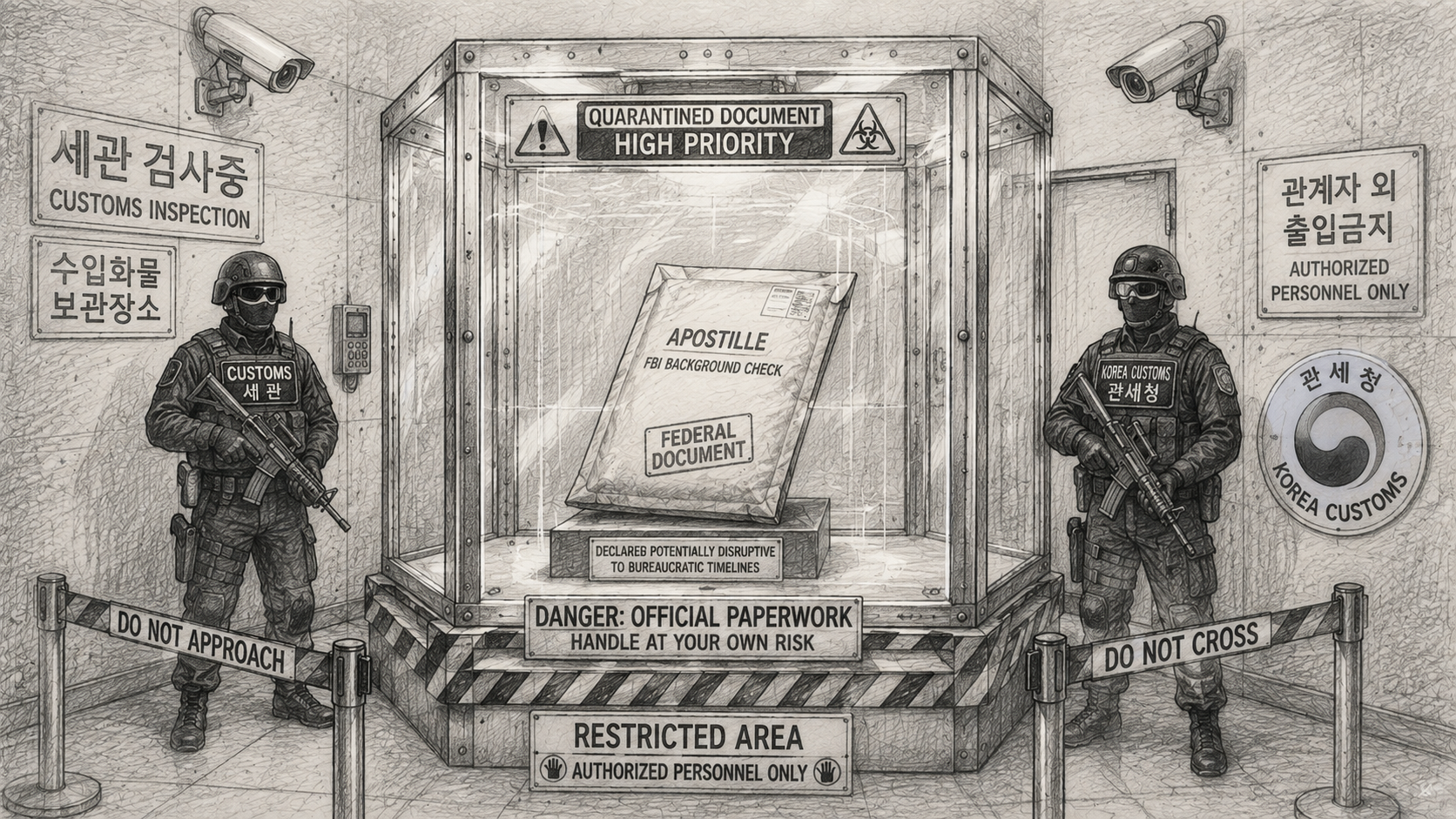
The new apostille is still stuck in customs!
Our immigration paperwork isn't.
Maybe I appreciate that more than most. I spent 22 years working inside two very large government organizations, SSA and NASA. I know why rules exist. I also know how easy it is to simply point to one and say, "Sorry, that's the rule."
This woman didn't ignore the rule. She understood why it existed, looked at the facts in front of her, and used good judgment.
After 22 years as a bureaucrat myself, I know just how much that matters.
And I know enough to be grateful when I meet one who gets it right.