A Short Read
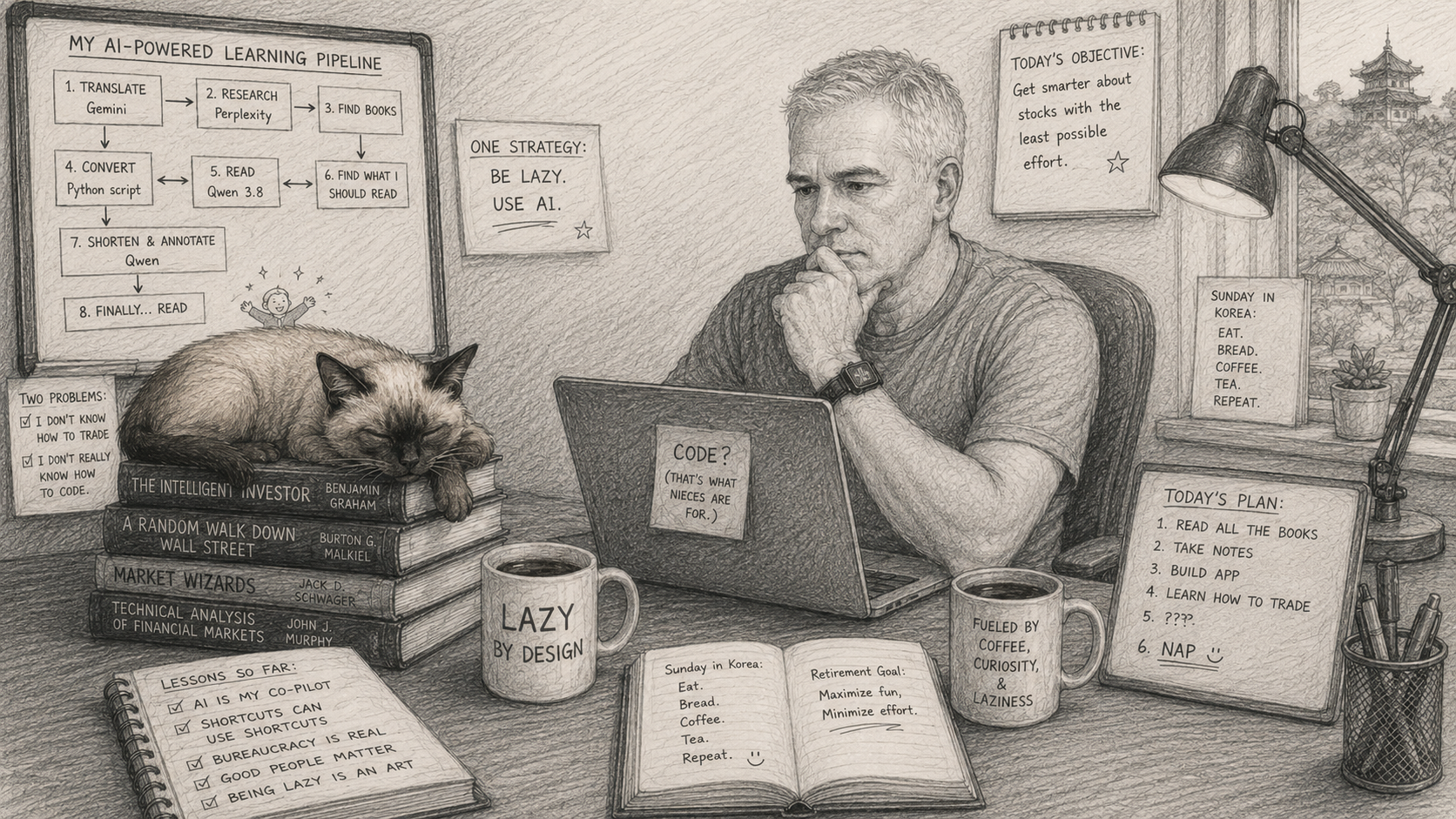
I'm working on a project with my niece; we're building a stock-trading dashboard together. Here's the thing: I know nothing about trading. But that's something I can fix, right? I mean, it's 2026. I can read a book or something.
Who's got time to read a book? I'm retired and I still don't have time to read. Well, maybe that's not entirely true. I'm in the middle of a sci-fi book about space wars, but that's entertainment, which is what retirement is really about, right?
Anyway, I digress. We've established that I don't know anything about trading, but there's another fun wrinkle to this story: we're building the dashboard in Korean. Now things are getting interesting.
My niece shared a couple of guidelines about how she invests so I could read up on them and build some basic knowledge before we got too far into the project. I ran them through Gemini and got solid translations, but there wasn't enough there for me to understand how all of this was supposed to work.
So I did what anyone would do in this situation: I asked Perplexity.
Perplexity gave me a good overview and pointed me toward a few classic trading books that could fill in the gaps. Better yet, my library had them, so I downloaded the ebooks.
That seemed like a good solution until I realized that I now had several books about subjects I didn't understand, and I was supposed to read them before I could get back to writing code for an app. Did I mention that I'm not a coder either?
Clearly, I needed another plan.
I'd already used Gemini to translate the source material, then Perplexity to figure out what it meant and point me toward better sources. I seemed to be on a roll, so there was no sense stopping now.
I went back to Gemini and asked how I could quickly review the books and pull out the parts that mattered to the specific topics I was trying to learn. Gemini told me I should first convert the ebooks into a format that large language models could easily read. Then it gave me a Python script to do it.
So, with careful guidance from my new big brother, I set it up and let it rip. Seconds later, I had plain-text versions of all the books, ready to feed into an LLM.
I opened Ollama, which is a desktop application that lets me run smaller AI models directly on my computer, and handed the books to Qwen 3.8. Qwen read them in about a minute, and then I started peppering it with questions, most of which probably made very little sense because, as previously established, I know nothing about trading.
After a while, though, I decided I really did want to read some of the material myself. I just didn't want to read all of it. So I asked Qwen to tell me which parts of the books would give me the most value for the least effort.
Its answer was almost comically aligned with my objective. It told me, in effect, that one of the authors was very good but very repetitive: the important ideas appeared clearly once, then got repeated, illustrated, defended, and repeated some more. I didn't need all of that. I needed the first clear explanation of each idea and the sections where the author turned it into something I could actually use.
Obviously, Qwen agreed with me.
It then produced several pages telling me exactly what to read: this chapter for this concept, another chapter for that one, these pages for this detail, another section for something else. It was a pretty impressive roadmap, and I was just about ready to open the first book and get started when something occurred to me.
Wait a minute.
I had just spent all this effort getting an AI to figure out which parts of the books I needed to read. Now I had several pages of instructions telling me how to go find all those parts.
I'd made my shortcut complicated.
Could I shortcut the shortcut?
So I went back to Qwen and asked another question:
Since you already know which parts of this ebook I should read, what if I give you the original EPUB and you cut it down to only those parts? And while you're at it, put your own comments and guidance into the book so I know what I'm supposed to notice while I'm reading it.
Qwen's answer was basically: sure. It couldn't quite hand me a finished EPUB, but it could get close enough that, with a little grunt work, I could turn the result into a much shorter book and drop it into Apple Books.
Which is what I'm doing now.
And somewhere along the way, I finally noticed what had happened.
I started with two problems: I don't know how to trade, and I don't really know how to code. So I used AI to translate the investing rules, then to research them, then to find the books, then to write the code that converted the books, then to read the books, then to tell me which parts I should read, and now I'm using it to build me a new, shorter book from those parts so I can finally sit down and learn something about trading.
I'm still not sure I know much about stocks.
But apparently I've gotten pretty good at being lazy.
If you don't hear from me for a little while, it must've worked.